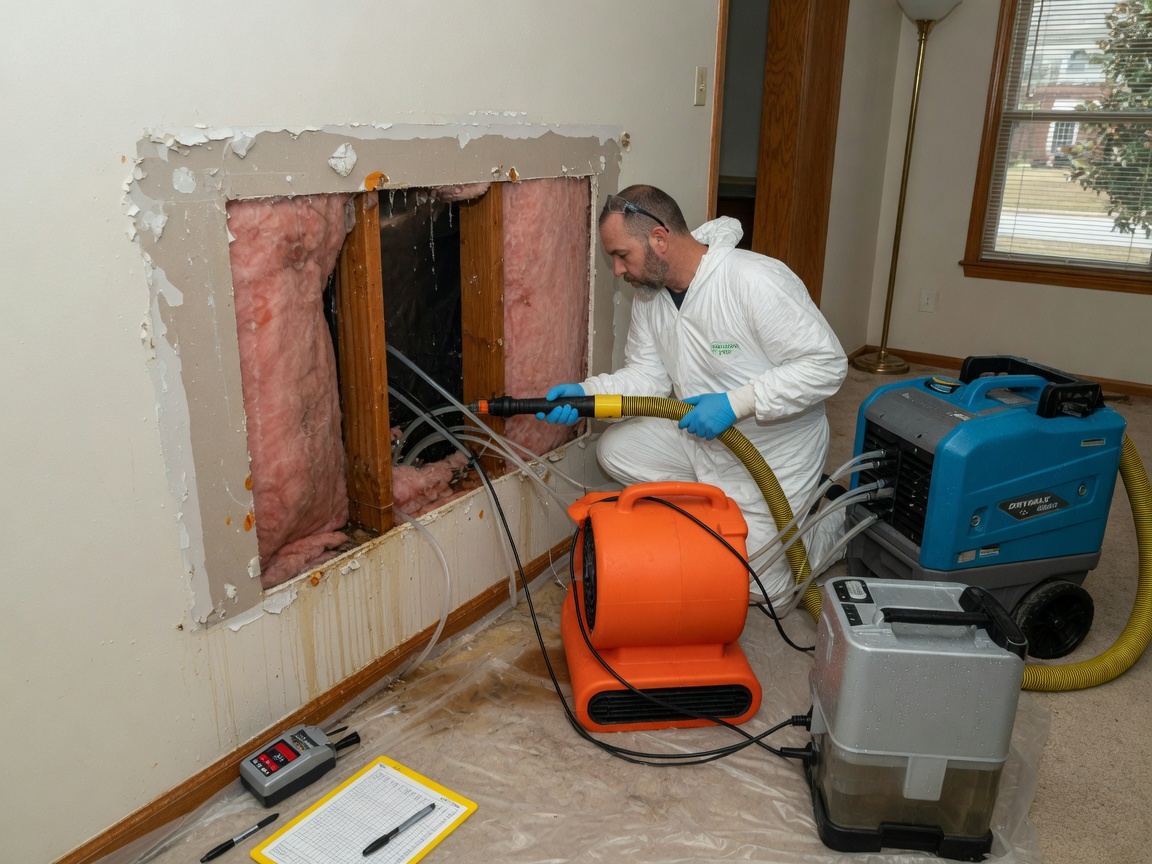
In Decatur's humid subtropical climate, water trapped behind drywall in homes built before 1970 in Old Decatur and Albany neighborhoods often travels upward through balloon framing and settles in wall cavities near the Tennessee River floodplain. Technicians use pin and pinless moisture meters plus infrared cameras to locate saturation levels above 18 percent without unnecessary demolition. Failure to address hidden moisture in these older plaster-and-lath or early drywall assemblies leads to recurring musty odors and mold within weeks once summer humidity returns.
Point Mallard and Beltline areas see frequent stormwater intrusion during heavy summer rains that overwhelm older crawlspaces and slab foundations. Wall cavity drying here requires negative-air machines and low-grain dehumidifiers running for three to seven days because ambient humidity rarely drops below 60 percent. Technicians drill small weep holes at base plates and crown moldings to allow airflow while preserving original trim in historic structures near the Princess Theatre district.
After extraction, crews monitor daily moisture readings until drywall reaches equilibrium with the surrounding air, typically 10 to 12 percent in Morgan County homes. Skipping this step leaves residual moisture that wicks into adjacent insulation and subflooring, especially in Riverbend properties where clay soils hold water against foundations. Homeowners are advised to remove baseboards and inspect for delamination before any repainting.
Technician insight
In Decatur the thing that catches most people out with wet drywall and wall cavity drying is how water travels horizontally through the balloon framing in 1940s–1960s homes in Albany and Old Decatur. One leak near the Cook Museum area can saturate an entire exterior wall before anyone notices because the clay soils and high summer humidity keep everything damp for weeks.
Hidden saturation after Beltline rain event
Heavy summer rain pushed water under the slab of a 1960s home in the Beltline neighborhood. Moisture had wicked three feet up interior walls. We mapped the cavities, removed only the bottom two feet of drywall, and ran cavity-specific drying for five days until readings matched ambient conditions. The homeowner avoided full wall replacement and returned to normal use within ten days.
Wet Drywall and Wall Cavity Drying Services We Offer
✓Wall Cavity Moisture Mapping
Infrared and meter-based scanning locates hidden saturation in cavities behind drywall after storms affecting Albany and Old Decatur homes.
✓Targeted Drywall Removal
Selective cutting of saturated sections preserves sound material while creating access for cavity drying in Point Mallard properties.
✓Cavity Airflow and Dehumidification
Placement of air movers and dehumidifiers inside wall cavities speeds drying in humid Morgan County summers without full wall demolition.
✓Base Plate and Sill Drying
Specialized equipment extracts moisture from bottom plates and sills common in pre-1980 homes near Decatur Morgan Hospital.
✓Post-Drying Moisture Verification
Final meter readings confirm cavities are dry before drywall replacement, preventing callbacks in Riverbend and Beltline neighborhoods.
Wet Drywall and Wall Cavity Drying Cost in Decatur, AL
| Service | Typical Range | What Affects It |
|---|---|---|
| Single wall cavity drying | $350–$650 | One to two linear feet of wall; price rises with multiple cavities or second-story access. |
| Full room wall drying | $800–$1,400 | Four walls plus base plates; older Albany homes often require extra monitoring days. |
| Moisture mapping only | $150–$275 | Diagnostic visit when extent of hidden water is unknown. |
Ranges are typical for Decatur, AL and confirmed with an exact written quote before any work starts.
How it works
- 1
Initial Assessment
Technicians inspect affected walls with moisture meters and cameras to map water migration in Decatur homes.
- 2
Controlled Demolition
Remove only saturated drywall sections while protecting unaffected areas and creating drying access points.
- 3
Cavity Drying Setup
Install air movers, dehumidifiers, and containment to pull moisture from wall cavities over several days.
- 4
Daily Monitoring
Return visits track moisture levels until readings stabilize with local humidity conditions.
- 5
Final Verification
Confirm all cavities are dry and ready for reconstruction before equipment removal.
Pricing
Cost depends on number of affected walls, access difficulty, and drying duration required by local humidity.